


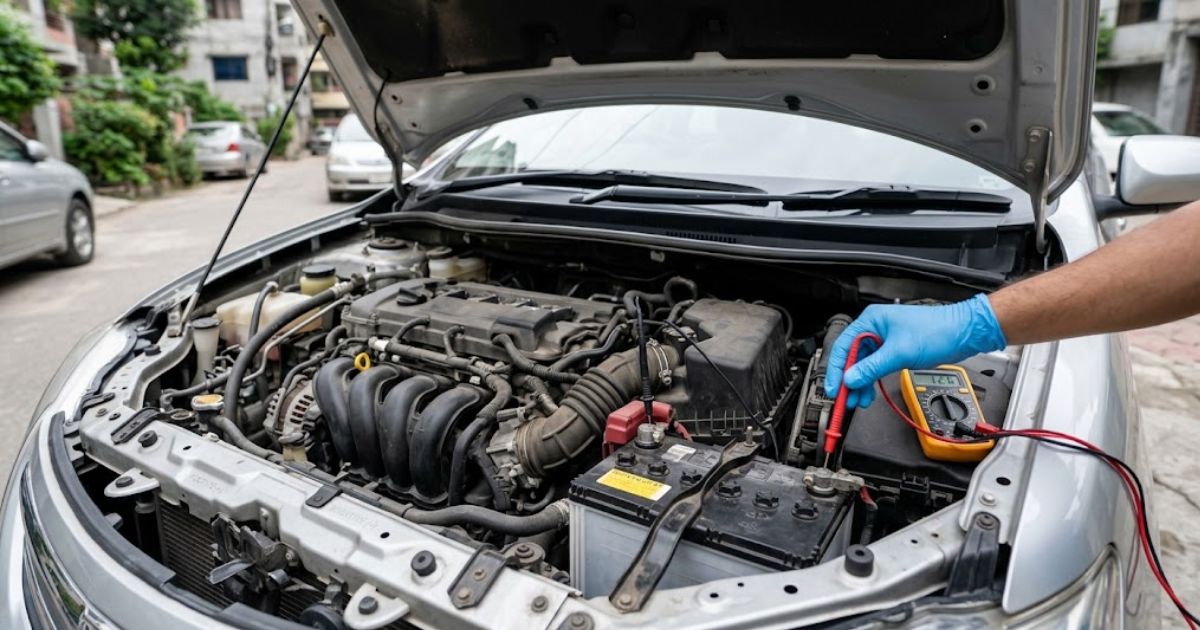
If your car won’t start, clicks when you turn the key, or the headlights look dim, your battery is probably weak.
All you need is a cheap digital multimeter (voltmeter) to find out if the battery is dead, dying, or totally fine.
Safety First
“Turn off the engine and remove the keys before testing. Wear eye protection and work gloves. Never allow metal tools to bridge the positive and negative terminals simultaneously, as this causes a direct short circuit and sparks.”
What the Warning Signs Mean
- Clicking noise or slow cranking: The battery is too weak to turn the starter.
- Red battery light stays on while driving: The alternator is failing to charge the battery.
- Car dies overnight: Either the battery cannot hold a charge, or something is draining it while parked.
The 4-Step Multimeter Test
Set your multimeter dial to DC Volts (20V). Put the red wire on the positive (+) terminal and the black wire on the negative (-) terminal.
1.Clear the ‘Surface Charge’:Wait 2 minutes.
Turn your car headlights on for 2 minutes with the engine off, then turn them off.
This removes fake surface voltage so your test reading is accurate.
2.Check Resting Voltage:Engine stays OFF.
Touch the red probe to + and black probe to -. Check the screen:
- 12.6V or higher: 100% full.
- 12.4V: Acceptable (about 75% full).
- 12.2V or lower: Weak battery; needs charging.
- Under 12.0V: Dead or failing battery.
3.Check Cranking Voltage:Requires 2 people.
Keep the probes on the battery while a friend starts the engine. Watch the screen drop:
- Stays at 10V or higher: Battery is strong and healthy.
- Drops below 9.6V: Battery is dying. Replace it soon.
- Drops below 5V: Battery is completely ruined. Replace immediately.
4.Check the Alternator:Engine idling.
Keep the engine running and look at the screen:
- 13.8V to 14.5V: Alternator is working properly and charging the battery.
- Stays near 12V: Alternator is bad and not sending power back to the battery.
Quick Fix: Check for Dirty Terminals First
Before buying a new battery, look at the metal posts on top of it.
If you see powdery blue, green, or white crust, power cannot flow properly.
- Put on glasses and gloves (battery powder is acidic).
- Loosen the metal clamps with a small wrench.
- Scrub the posts and inside of the clamps with sandpaper until you see shiny metal.
- Tighten the clamps back on firmly.
- Spray a quick squirt of WD-40 or apply petroleum jelly on the outside to stop rust and corrosion.
When to Replace the Battery
- Most car batteries only last 3 to 4 years.
- If a battery charges up to 12.6V, sits overnight disconnected, and drops below 10V by morning, the inside cells are broken. It must be replaced.
- Most local auto parts shops will test your battery and alternator for free with their handheld diagnostic machines if you don’t want to buy a meter.
Frequently Asked Questions
How do I know if my car battery or alternator is bad?
If your engine won’t turn over or just clicks, jump-start the vehicle. If it starts and stays running after removing the cables, the battery is likely dead. If the engine dies shortly after taking off the jumper cables, or if the red battery dashboard light stays on while driving, the alternator is typically at fault.
Can a bad battery ruin an alternator?
Yes. A battery with dead or shorted internal cells forces the alternator to constantly run at maximum output to compensate. Over time, this extra load overheats the alternator’s internal voltage regulator and diodes, causing premature failure.
Why does my battery keep dying overnight?
If the battery tests healthy, you likely have a parasitic drain. This occurs when an electrical component such as an aftermarket dashcam, alarm system, glove box light, or faulty relay continues to pull power after the car is locked and turned off.
How long should I drive to recharge a dead battery after a jump?
Drive continuously at highway speeds for at least 20 to 30 minutes. Short trips around the block do not give the alternator enough runtime to return a deeply drained battery to a healthy state of charge.
Does cold weather kill car batteries?
Cold weather doesn’t usually cause internal damage; summer heat does. Extreme engine bay heat accelerates plate corrosion and electrolyte evaporation. When winter arrives, the battery’s chemical reaction slows down, exposing the degradation that already occurred during the summer.
What is the difference between an AGM battery and a standard lead-acid battery?
Standard lead-acid batteries contain liquid electrolyte, while AGM (Absorbent Glass Mat) batteries suspend the acid in fine fiberglass mats. AGM batteries handle deeper discharge cycles, recharge faster, and resist vibrations better. Vehicles with automatic start-stop engines require AGM or EFB batteries to handle frequent engine restarts.